


Lower Trapezius Tendon Transfer Surgeon in East Providence, RI
Patients with massive rotator cuff tears that are not repairable with pain and loss of shoulder function may be candidates for lower trapezius tendon transfer surgery. This advanced procedure is designed to help restore external rotation strength and improve shoulder motion while reducing pain. Dr. Paxton provides comprehensive evaluation and individualized treatment options for complex shoulder conditions, including lower trapezius tendon transfer surgery in Rhode Island. Contact Dr. Paxton’s office today to schedule an appointment.
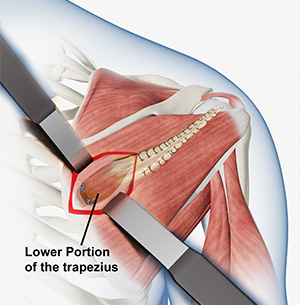
What is a Lower Trapezius Tendon Transfer?
Lower trapezius tendon transfer is an advanced shoulder reconstruction procedure used to treat massive irreparable rotator cuff tears, particularly in patients who have difficulty externally rotating the arm. Individuals with this condition may struggle with activities such as reaching outward, maintaining a throwing position, or controlling arm movement in space, or maybe even just raising their arm.
When the rotator cuff muscles and tendons are torn beyond repair, a nearby muscle is transferred from its normal location to replicate the function of the top and back portion of the rotator cuff.
This procedure works by transferring the lower trapezius tendon (1/3rd of the overall trapezius) from its normal attachment on the shoulder blade to the upper part of the arm bone (humerus). The lower trapezius is not long enough to reach that far, so a tendon graft (achilles tendon from a cadaver) is used to attach the good lower trapezius muscle to the upper part of the humerus bone where the rotator cuff is no longer attached. The lower trapezius muscle normally helps stabilize and retract the shoulder blade, but when transferred, it can assist in restoring external rotation of the shoulder.
Ideal Candidates for Lower Trapezius Tendon Transfer
Lower trapezius tendon transfer may be recommended for patients who:
- Have a massive irreparable rotator cuff tear (either primary or after a failed previous repair)
- Experience weakness with external rotation of the shoulder
- Have difficulty controlling arm motion in space
- Are unable to maintain a throwing position
- Want to maintain a more active lifestyle
- Prefer an alternative to shoulder replacement surgery
- Have failed previous rotator cuff procedures
This procedure is often considered for younger or more active patients who may not be ideal candidates for reverse shoulder replacement.
Lower Trapezius Tendon Transfer Procedure
Lower trapezius tendon transfer surgery is typically performed on an outpatient basis under general anesthesia and generally takes between 1-2 hours.
During the procedure:
- Arthroscopic techniques are used to evaluate and prepare the shoulder joint
- A small incision is made near the shoulder blade to access the lower trapezius tendon
- A tendon graft, commonly an Achilles tendon allograft, is attached to the humeral head using suture anchors
- The graft is then connected to the lower trapezius tendon using specialized suturing techniques
- The transferred tendon helps restore external rotation and improve shoulder mechanics
- After surgery the arm is immobilized in a position to reduce tension on the graft for 6 weeks.
Dr. Paxton utilizes advanced surgical techniques tailored to each patient’s individual shoulder condition and functional goals.
Why Does Lower Trapezius Tendon Transfer Help?
The lower trapezius muscle naturally works to stabilize and retract the scapula (shoulder blade). By transferring the tendon to a new position, the muscle can help restore external rotation of the arm and improve shoulder stability.
Over time, physical therapy and muscle retraining help the brain adapt to the new mechanics of the shoulder. Biomechanical studies have demonstrated that lower trapezius tendon transfer may provide improved restoration of shoulder motion compared to other tendon transfer procedures for certain patients.
Recovery After Lower Trapezius Tendon Transfer
Following surgery, the arm is typically placed in a specialized brace that maintains the shoulder in external rotation for approximately 6 weeks.
General postoperative guidelines may include:
- Wearing a protective brace as directed
- Avoiding internal rotation movements during early healing
- Beginning physical therapy approximately 6 weeks after surgery
- Gradually increasing shoulder strength and mobility over 6 months
- Protecting the tendon repair during the healing process
Complete healing of the tendon transfer generally takes 6-9 months, while improvements in strength and shoulder function may continue for up to one year following surgery.
Risks and Complications of Lower Trapezius Tendon Transfer
As with any surgical procedure, lower trapezius tendon transfer may carry certain risks and complications, including:
- Infection
- Bleeding
- Stiffness
- Nerve injury
- Failure of tendon healing
- Persistent weakness
- Limited range of motion
- Re-tear or graft complications
- Continued shoulder pain
If you would like additional information on treatment options for complex rotator cuff tears or to learn more about lower trapezius tendon transfer surgery, please contact Dr. Paxton, serving patients in East Providence, RI.